
Picking web analytics shouldn’t feel like buying a jet just to drive to the grocery store. The “right” tool depends on your traffic scale, data sensitivity, resources, and the questions your business needs answered. This guide gives you a practical, jargon-free way to shortlist options, compare them side-by-side, and document your choice with stakeholder-friendly screenshots.
Start with your use cases
Before you compare brands, write down the decisions you want analytics to inform in the next 6–12 months:
- Acquisition: Which channels send qualified visitors? What should we scale back?
- Product/content: Which pages or features keep people engaged?
- Monetization: What drives conversions or leads? What blocks them?
- Compliance: What privacy constraints (GDPR/CCPA/ePrivacy) must we respect?
- Workflow: Who will read the reports, and how often? Email digests, dashboards, exports?

Map each decision to must-have capabilities. For example:
- “Prove content ROI” → per-page goals, UTM reporting, simple content grouping.
- “Privacy by design” → cookieless or consent-mode, IP anonymization, EU hosting.
- “Team of non-tech users” → clean dashboards, scheduled emails, one-click CSV.
Tool categories at a glance
- Mainstream, free, feature-rich (e.g., GA4): Deep reports, broad ecosystem. Trade-offs: learning curve, consent complexity.
- Privacy-first lightweight (e.g., Plausible, Fathom, Simple Analytics): Fast, simple, cookieless by default. Trade-offs: fewer “advanced” views, but enough for most SMBs.
- Self-hosted (e.g., Matomo On-Premise, Umami OSS): Data stays with you. Trade-offs: you manage hosting and updates.
- Enterprise suites (e.g., Adobe Analytics): Custom schemas, integrations, and robust governance. Trade-offs: price and specialized skills.
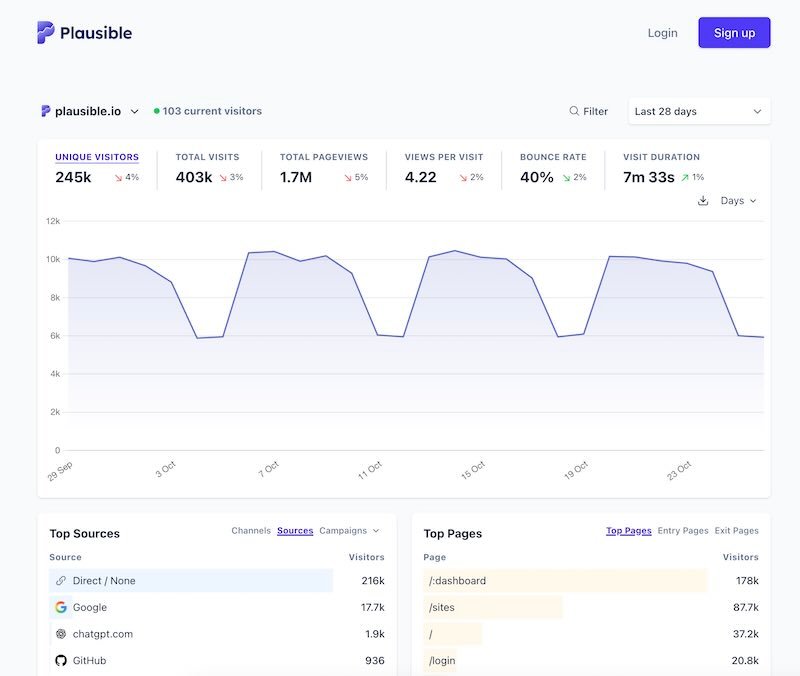
Plausible
Plausible offers a minimalist dashboard with simple and clear data visualization. The interface displays key metrics on a single screen: number of unique visitors, page views, bounce rate, and time spent on the site. The traffic graph is displayed at the top, and below are the top pages, traffic sources, visitor countries, and devices. All data loads quickly and does not require complex configuration.
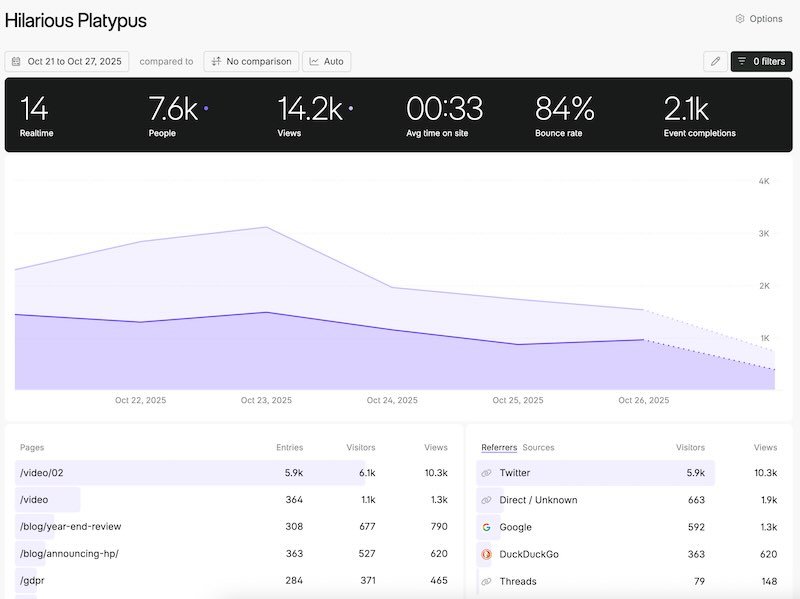
Fathom Analytics
Fathom Analytics features an elegant and intuitive interface with an emphasis on privacy. The dashboard presents data in clear graphs with time trends, showing visits, unique visitors, and average time on site. The interface includes detailed statistics on popular pages, referral sources, and UTM tags. All metrics are displayed in real time without the use of cookies.
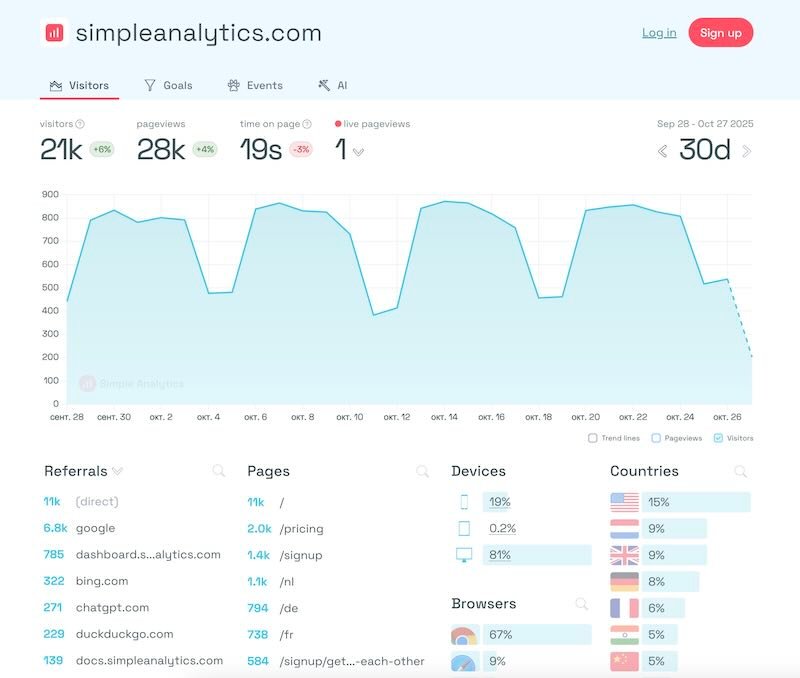
Simple Analytics
Simple Analytics lives up to its name by providing a highly simplified interface for traffic analysis. The main screen displays a linear graph of traffic with the ability to switch between time periods, a list of the most visited pages, traffic sources, and the geographical distribution of visitors. The platform focuses on the most important metrics, excluding redundant information and ensuring full GDPR compliance.
Comparison table
Use this as a starting point; your requirements may weigh columns differently.
| Tool | Best For | Privacy & Data Location | Setup Complexity | Ecommerce/Goals | Reporting Depth | Exports & APIs | Pricing Model | Learning Curve |
|---|---|---|---|---|---|---|---|---|
| GA4 | Free, deep multi-channel analysis | Consent-sensitive; data in Google infra | Moderate (tag + event mapping) | Strong (events, conversions) | High (explorations, cohorts) | BigQuery export, API | Free (paid add-ons via cloud) | Steeper for non-analysts |
| Plausible | SMBs, content sites, agencies | Cookieless by default; EU hosting options | Easy (single script) | Events & goals | Enough for SMBs | Robust Stats API, CSV | Pageview-based subscription | Easy |
| Fathom | Owners who want instant clarity | Cookieless; privacy-first hosting | Easy (single script) | Goals | Focused, at-a-glance | One-click CSV | Pageview-based subscription | Easiest |
| Simple Analytics | Non-tech teams needing summaries + exports | Cookieless; EU-friendly | Easy (single script) | Events/goals | Clean summaries & trends | API + CSV | Pageview-based subscription | Easy |
| Matomo (On-Prem) | Regulated orgs, strict data ownership | You host; full control | Moderate–High (self-host) | Strong | Broad, classic GA-style | DB/CSV/API | Free core (add-ons) | Moderate |
| Adobe Analytics | Enterprises, advanced governance | Enterprise hosting & controls | High (implementation + schema) | Very strong | Very high, customizable | Enterprise connectors | Enterprise contracts | High |
How to read this table:
- If your top priority is privacy and simplicity, start with Plausible / Fathom / Simple Analytics.
- If you need deep analysis and free tooling, consider GA4.
- If data residency and ownership are non-negotiable, consider Matomo On-Prem (or another self-hosted tool).
- If you’re an enterprise with complex pipelines and data teams, Adobe Analytics is purpose-built.
Decision framework
- List stakeholders: Who needs what?
- Founders: weekly sales + top channels
- Marketers: campaign UTMs + conversions
- Content team: top pages + engagement
- Compliance: consent, retention, data residency

- Score the must-haves (1–5) for each tool:
- Consent/cookieless
- Ease for non-tech roles
- Goals & funnels
- UTM & campaign clarity
- Exports (CSV/API/warehouse)
- Cost predictability
- Pick two finalists and validate with a 7-day test:
- Can a non-technical stakeholder read the dashboard and explain what’s working in 5 minutes?
- Can you export a month-end CSV without asking an analyst for help?
- Do privacy settings align with your policy and user consent flow?

Practical pros & cons by scenario
Content-led SMB or agency
- Likely fit: Plausible, Fathom, Simple Analytics
- Why: Easy setup, fast dashboards, digestible weekly reports, cookieless by default.
- Watch-outs: If you rely on very granular pathing or audience modeling, you’ll outgrow simplicity.
Ecommerce with limited resources
- Likely fit: GA4 (for deep commerce events) or Simple Analytics (if you primarily need top-line trends + goals)
- Why: GA4 has richer event modeling; Simple Analytics offers clarity for non-tech teams.
- Watch-outs: GA4 learning curve; ensure consent/compliance is configured properly.
Regulated industries / public sector
- Likely fit: Matomo On-Prem (or a similar self-hosted stack)
- Why: Data ownership and residency controls.
- Watch-outs: Provisioning and maintenance overhead.
Data team + BI pipeline
- Likely fit: GA4 (BigQuery) or Plausible (Stats API)
- Why: Smooth data access for dashboards and modeling.
- Watch-outs: Decide early on event schema and naming to avoid rework.
Cost vs. value
- Time to insight: If it takes longer than five minutes to answer “what worked this week,” the tool is too heavy.
- Adoption: The best analytics is the one your team opens and uses.
- Lock-in risk: Prefer tools with CSV/API exports so you can take your data with you.
- Privacy posture: Pick a tool that makes compliance hard to mess up. Our Search Console integration guide shows how privacy-safe SEO analytics works in practice.

Ethan Lewis is an SEO strategist and web analytics consultant with over 8 years of experience helping businesses turn data into growth. He specializes in privacy-compliant analytics, technical SEO, and conversion optimization. At Statlyzer, Ethan writes in-depth guides that make complex analytics topics accessible to marketers and website owners.