
Growth isn’t just “more customers”; it’s the right mix of acquisition and retention. Read your ratio of new vs returning customers correctly and you’ll spot whether your marketing strategy is building a durable engine—or masking a leaky bucket.
Definitions that matter (and where confusion creeps in)
A new customer is someone who completes their first purchase within your lookback window. A returning customer has bought before and comes back for another order. Sounds simple, but identity is messy: users switch devices, clear cookies, and shop across channels. The post-cookie analytics landscape makes this identity puzzle even trickier. Treat the ratio as directional, then validate with cohort analysis and revenue views.
Also note the difference between customers and visitors. Many analytics tools surface the mix as traffic first, revenue second. Keep both on the table: traffic mix shows how you fill the funnel; revenue mix shows who sustains the business. Shopify’s metric for returning customer rate is a useful reference when aligning teams.
What the balance signals about your business
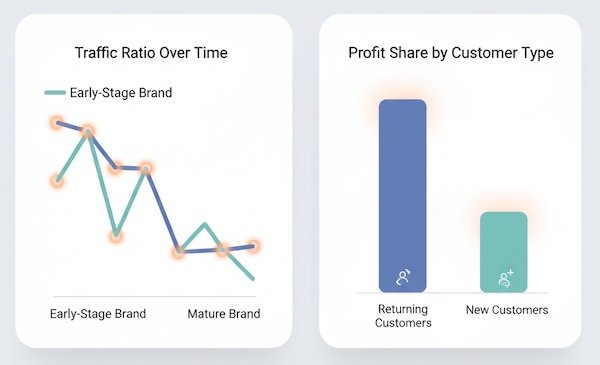
Think of your ratio as a diagnostic, not a target. It reflects four things:
- Lifecycle stage
Young brands skew to acquisition; mature brands should lean into repeat. If a five-year-old store still relies on 80% first-time buyers, retention isn’t compounding. - Economics
Customer Acquisition Cost (CAC) is paid upfront; profit is realized over time. A healthy share of repeat revenue is how you harvest the margin you planted with CAC. - Product-market fit
High organic repeat purchasing—without permanent discounts—signals real value. Heavy discount dependence among repeaters suggests price sensitivity, not loyalty. - Channel mix
Paid social and affiliates tend to skew “new”; email, SMS, and direct/brand search skew “returning.” Our Search Console integration guide shows how to measure organic search contribution accurately. Invest according to strategic gaps, not channel vanity.
So… what is a good new vs returning visitor ratio?
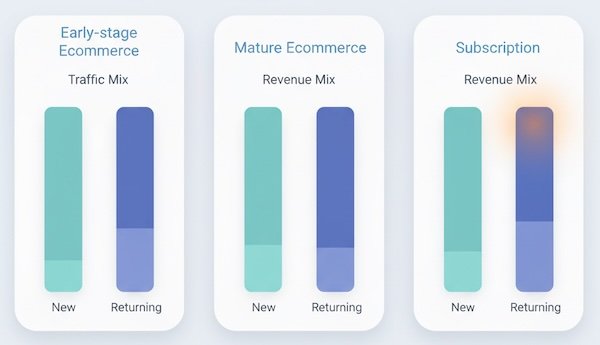
There’s no universal “golden number,” but there are sensible bands by model:
- Early-stage e-commerce: 60–80% new visitors, 20–40% returning visitors. You’re still widening top-of-funnel while collecting the first cohorts.
- Mature e-commerce with replenishment or accessories: 40–60% new, 40–60% returning—stable or slightly returning-heavy as repeat behaviors kick in.
- Subscription (SaaS/consumer): traffic may stay new-heavy, but revenue should skew returning; expansions, renewals, and upsells dominate value.
Treat these as starting points, not grades. The smarter question is: does your mix support profitability at your current CAC and margins?
(Yes, people Google “what is a good new vs returning visitor ratio.” The honest answer: the one that funds growth with acceptable CAC payback and rising LTV.)
Read the ratio through a revenue lens
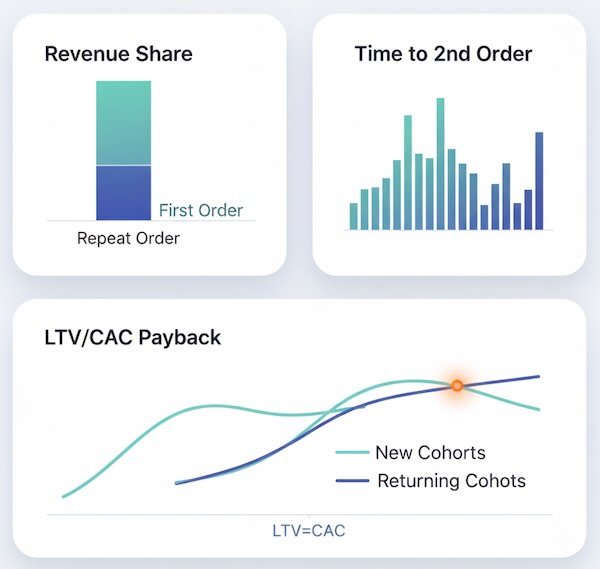
Traffic shares can mislead. Always pair the mix with revenue and profit:
- First-order share of revenue: If first orders drive >70% of revenue long after launch, your cohorts may be weak—or promotion-heavy.
- Repeat rate and time to second order: How many customers buy again, and how fast? Shortening the gap is often worth more than lifting first-order conversion.
- LTV/CAC by cohort: Plot payback. If returning revenue doesn’t cover CAC within your cash window, acquisition-heavy growth will strain cash.
This is where the “importance of new customers” and the strength of existing ones meet. You need both: acquisition to feed the base, retention to monetize it.
When the mix is skewed—what it usually means
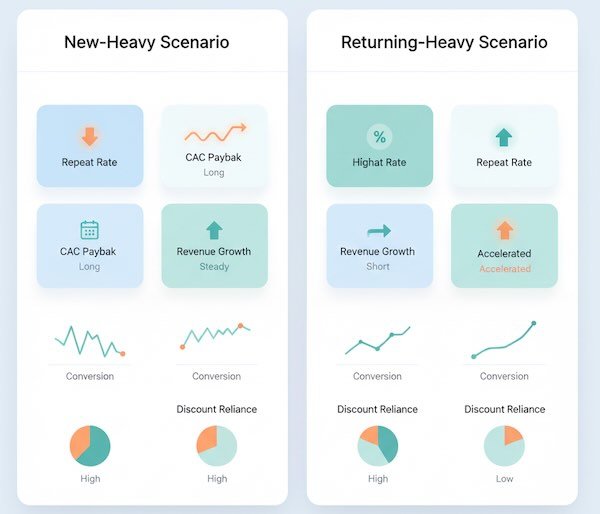
Too many new customers (or new-heavy traffic):
- Symptoms: High paid spend, flat LTV/CAC, repeat rate below category norms.
- Likely cause: Leaky onboarding, weak merchandising for second purchase, or misaligned pricing/promos.
- Strategic takeaway: Balance the spend curve; emphasize post-purchase value, lifecycle offers, and product pathways that create reasons to return.
Too many returning customers (or returning-heavy traffic) with stagnant growth:
- Symptoms: Flat top-line, saturated remarketing, rising frequency but shrinking reach.
- Likely cause: Under-invested prospecting, brand fatigue, or overreliance on email/loyalty.
- Strategic takeaway: Rebuild awareness and discovery. If new customers vs existing customers tilts too far to the latter, your pipeline will dry up.
Compare like with like: timeframe, category, intent
- Timeframe: Ratios swing by season. Use rolling 4–12 week windows and year-over-year comps for a clean read.
- Category norms: Groceries and beauty replenish quickly; furniture and luxury don’t. Benchmark against the closest peer set, not generic industry averages.
- Intent mix: Branded search is retention-coded; generic search and social prospecting are acquisition-coded. Read the mix by intent, not only by channel.
Segment the ratio to learn why, not just what
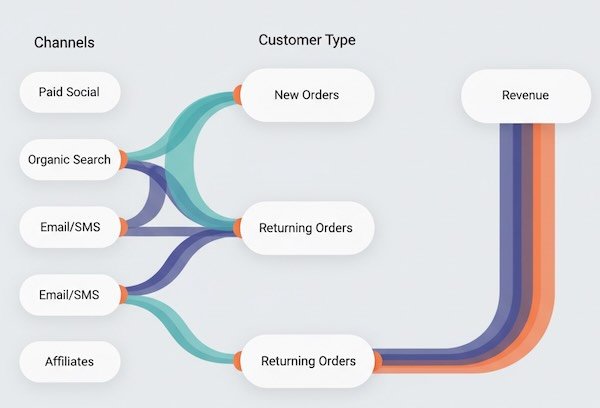
- By channel: Which sources truly bring incremental first-timers? Which mostly recycle existing buyers?
- By product family: Entry SKUs and bundles often acquire; accessories and refills retain. See if product strategy aligns with funnel role.
- By geography/device: Mobile tends to be acquisition-heavy; desktop often carries considered repeat purchases.
- By price band: High-ticket first orders may need content and financing nudges to unlock a second purchase path.
The segments will reveal whether you’re accidentally funding reacquisition (paying to bring back your own customers) or genuinely expanding reach.
Interpreting common ratios—quick heuristics
- 70/30 new/returning traffic, flat revenue: Acquisition is masking retention issues. Investigate time-to-second-order and discount dependence.
- 50/50 traffic, but 80% of revenue from repeat: Efficient base monetization; ensure acquisition isn’t starved or you’ll plateau.
- 60/40 returning/new traffic and rising revenue: Brand strength and word-of-mouth; check saturation risk and explore new audiences before growth slows.
Avoid these pitfalls
- Counting visitors, not people: Identity resolution is imperfect; triangulate with purchase data and cohorts. The right analytics tool helps you get closer to real counts.
- Chasing a magic ratio: Targets without LTV/CAC context can push perverse incentives (cheap traffic that never buys again).
- Confusing promotions for loyalty: A coupon-trained “returning customer” leaves when the discount does. Watch net margin, not just repeat rate.
- Ignoring payback: A balanced mix that never pays back CAC isn’t balance—it’s burn.
Decision checklist for marketers and leaders
Ask these questions in your monthly review:
- Does our mix of new vs returning customers align with our stage and cash constraints?
- Are first orders profitable enough—or is the model built on payback from repeat?
- Which channels deliver incremental new—and which mostly retarget existing?
- Are there product paths that naturally lead to repeat (consumables, accessories, refills)?
- What is our current answer to “what is a good new vs returning visitor ratio” for our model, and is it tied to LTV/CAC?
Bottom line
Healthy growth is a relay: acquisition hands the baton to retention, and retention powers margin that funds the next lap of acquisition. Get the balance right and both teams win. Frame your analysis around new customers vs existing customers, but judge success by customer economics—repeat behavior, margin, and payback—not by a single percentage on a dashboard. For a primer on the metrics that matter, read What Is Web Analytics and Why Should I Care?

Ethan Lewis is an SEO strategist and web analytics consultant with over 8 years of experience helping businesses turn data into growth. He specializes in privacy-compliant analytics, technical SEO, and conversion optimization. At Statlyzer, Ethan writes in-depth guides that make complex analytics topics accessible to marketers and website owners.